TEL: +86-573-87471884 / 87471697
FAX: +86-573-87471537
Address: No. 205 Xinjiang Road Changan Haining, Zhejiang, China
E-mail: howardshen@263.net, goldcitylock@hotmail.com
Welcome to our website!

 Language

A double locking padlock normally retains both shackle legs inside the body, rather than holding only one side. The label does not prove which locking parts are used, how they release, or how the finished lock performs under attack.
Bulk buyers should therefore confirm the number of engagement points, the locking-element type, the shackle and body geometry, and the evidence attached to any performance claim.
This guide is for importers, distributors, specification buyers, and private-label teams comparing steel-ball, ball-bearing, and other double-locking descriptions before requesting samples or placing repeat orders.
In a typical double-locking arrangement, a locking element engages each shackle leg when the lock is closed. Unlocking retracts or moves those elements so the shackle can open. Some designs use steel balls or ball bearings; others may use bars, bolts, or supplier-specific parts. The purchase description should identify the actual arrangement rather than relying on the words double locking alone.
Treat the term as a mechanism question, not a security grade. Two engagement points may change how the shackle remains retained after one side is cut or loaded, but the outcome depends on materials, dimensions, tolerances, body construction, the hasp, and the test method. Without a stated test and result, a buyer can verify configuration but should not assign an attack rating.
Supplier language is not fully standardised. Double ball bearing locking usually describes a ball at each shackle leg. Steel ball locking may describe the same general principle, but the ball material, number, shape, and release path still need confirmation. Double bolted can refer to two bars or bolts rather than balls.
A brand containing the words double lock and a double-locking safety hasp are different products and should be excluded from a padlock-mechanism comparison.
Term in a quotation | What it may describe | Buyer verification |
Double locking | Both shackle legs retained | Engagement drawing and unlocking action |
Double ball bearing | One ball-bearing element at each leg | Ball positions, material, and shackle grooves |
Steel ball locking | Steel-ball retention inside the body | Number of balls and model-specific construction |
Closed or half-closed shackle | External body coverage around the shackle | Fit, exposure, and clearance; not the internal mechanism |
The GOLD CITY steel-ball-locking padlock range is a useful example of why terminology must be normalised before quote comparison. Record the supplier's words, then ask for a model drawing or written confirmation that answers the same mechanism questions for every quotation.
A single-locking design retains one shackle leg, while the other side may be fixed, sprung, or shaped according to the design. A double-locking design retains both legs. For procurement, the useful comparison is whether both engagement points remain seated when closed, how the key or combination releases them, and whether relocking occurs consistently across a sample set.
Do not convert that mechanical difference into an unsupported statement that one product is universally secure, cut-proof, or pick-resistant. If an application requires a recognised grade, insurer acceptance, or a defined attack test, name the required scheme and request a model-specific report from an appropriate source. A mechanism description and a performance result answer different purchasing questions.
Open, long, closed, and half-closed describe how the body surrounds the shackle and how much clearance is available at the locking point. Double locking describes internal retention.
A closed-shackle padlock can use double locking, but its external coverage does not prove the mechanism. Likewise, an open-shackle model may retain both legs even though more of the shackle remains visible.
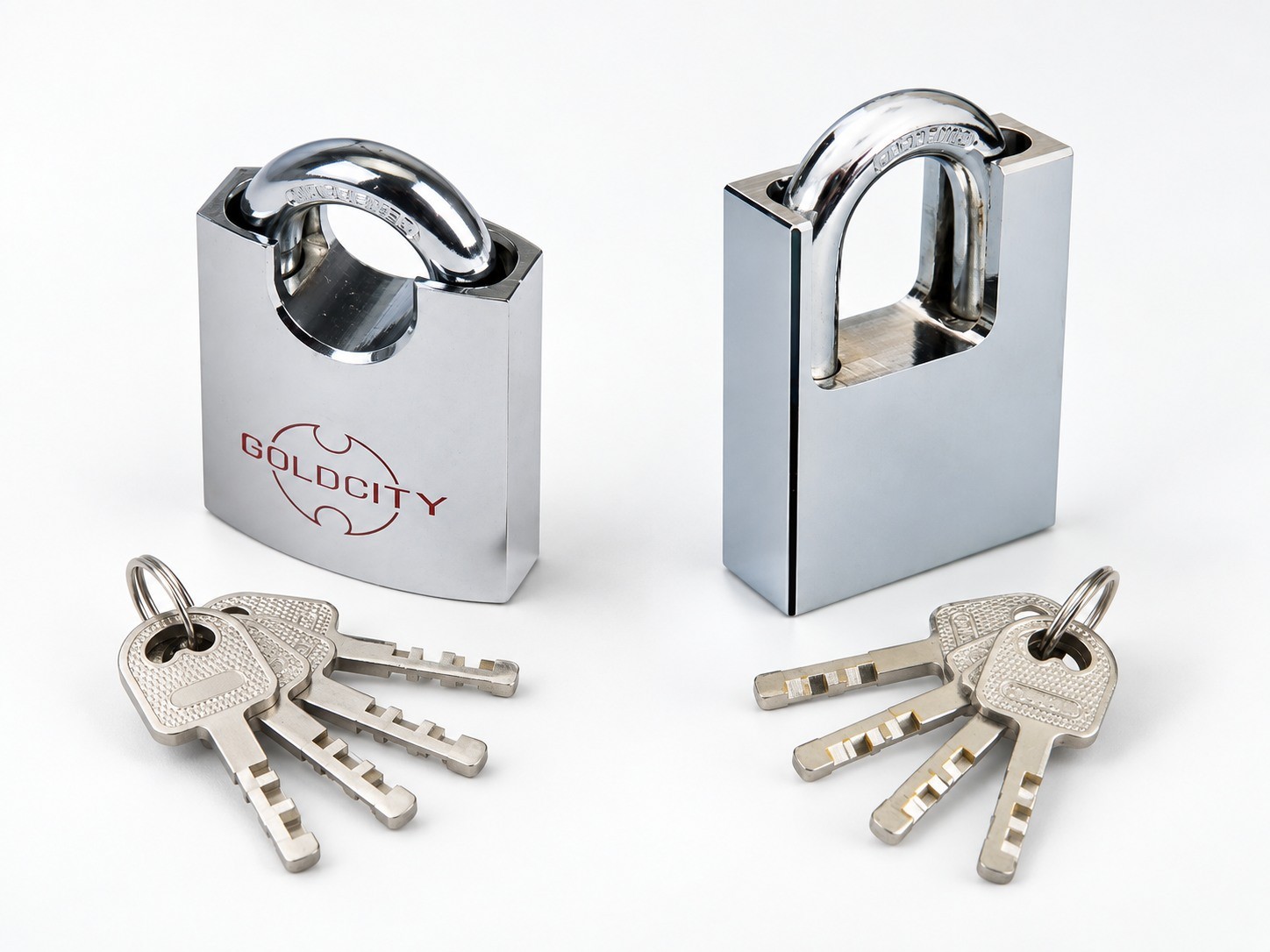
GOLD CITY publishes closed-shackle brass models numbered NO.7001-7009 and a separate half-closed-shackle range numbered NO.70140-70155. These model groups let a buyer compare external coverage within the steel-ball-locking category.
The final choice still depends on shackle diameter, usable opening, body envelope, key access, and the hasp or chain that receives the lock.
More shackle coverage can reduce working clearance. That trade-off matters on recessed hasps, thick chains, and fittings that need the body to rotate during installation. Define mechanism and geometry as separate RFQ fields so a supplier does not satisfy one requirement while making the lock unusable at the intended point.
A comparable RFQ gives every supplier the same operating condition and asks the same verification questions. Start with the asset and receiving hardware, then define the lock.
If the internal construction is commercially sensitive, request a sectional drawing, annotated mechanism sketch, or written confirmation sufficient to verify the engagement points without demanding proprietary production details.
· Application, hasp or chain type, and critical fit dimensions
· Required number of shackle engagement points when locked
· Locking-element type, such as steel ball, ball bearing, bar, or bolt
· Body material, shackle material, diameter, opening, and external form
· Keying or combination requirement kept separate from the locking mechanism
· Quantity, destination market, packing, labelling, and repeat-order reference
· Required sample, drawing, test evidence, and acceptance checks
Ask suppliers to identify any deviation rather than silently substituting a similar term. A quote for double locking that does not state the engagement method may still be valid, but it is not yet comparable with a quote that specifies two steel balls. Resolve that difference before price, packing density, or delivery planning becomes the deciding factor.
GOLD CITY places closed- and half-closed-shackle brass models within its steel-ball-locking category. NO.7001-7009 identifies the closed-shackle family, while NO.70140-70155 identifies the half-closed family.
These references give a buyer a concrete starting point for discussing engagement method and external coverage as separate requirements. The requested mechanism and any performance evidence must be confirmed for the selected model.
This separation keeps model selection tied to a documented buyer requirement.
The GOLD CITY heavy-duty brass padlock series HL400A-HL407A identifies shackle double locking alongside a solid-brass body and hardened-steel shackle. The stainless-steel padlock series HL403SS-HL406SS also identifies shackle double locking, with a stainless-steel body and shackle plus a brass cylinder and pins.
Buyers can use these published fields to shortlist a construction, then verify the exact engagement detail, fit, keying, evidence, and sample against the intended application.
Compare the sample with the approved drawing or written mechanism description. With the lock open, inspect the visible locking elements without dismantling the product. With it closed, confirm that both engagement points seat consistently and that unlocking releases them as specified.
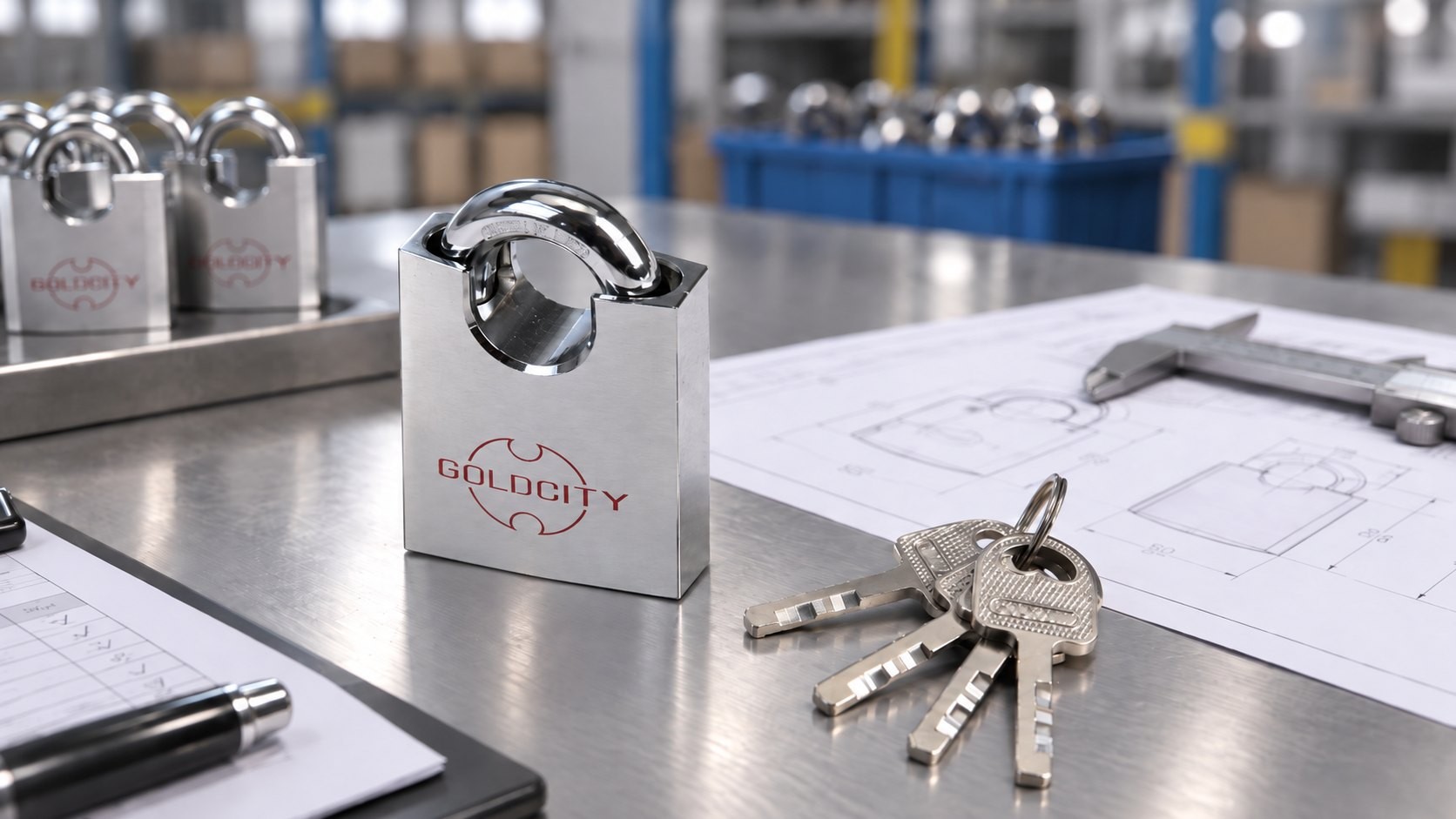
Repeat the check across the agreed sample quantity and record any sticking, incomplete engagement, or variation. Photograph the locked sample and identify the hardware used for approval.
Test the lock on representative hardware as well. Confirm that the chosen shackle form fits, the key remains accessible, and the body does not interfere with the hasp. Verify model marking, keying, packing, and the reference that will be retained for production inspection. Functional approval confirms the agreed sample; it does not create an untested security grade.
· Using double locking without defining the number and type of engagement points
· Treating closed shackle as proof of a particular internal mechanism
· Confusing a double-lock brand or lockout hasp with a double-locking padlock
· Adding high security or attack-resistant language without a named test and result
· Changing geometry, keying, or packing on a reorder without a controlled revision
A double locking padlock specification should state what retains each shackle leg, how the mechanism releases, and which external geometry fits the application. Keep mechanism, shackle form, keying, and performance evidence in separate fields. That structure makes quotations easier to compare and gives the sample inspection a clear acceptance basis without relying on marketing labels.
For a model review, Contact GOLD CITY with the application, mechanism description, shackle and body dimensions, quantity, keying, destination market, packing, drawing, and sample requirements.
Not always. Double locking normally means that both shackle legs are retained. Double ball bearing locking describes one way to achieve that result. A supplier may use balls, bars, bolts, or another design, so confirm the model-specific mechanism.
No. It describes a locking arrangement, not a recognised grade or test result. If the purchase requires EN 12320, CEN, Sold Secure, insurer acceptance, or another scheme, request evidence that identifies the exact model, scope, and result.
No. Closed shackle describes how the body covers the shackle. Double locking describes how the shackle is retained internally. Confirm both fields independently and test the resulting geometry on the intended hasp or chain.
Verify both engagement points, the unlocking action, model and dimensions, fit on representative hardware, keying, markings, packing, and the production reference. Keep the approved drawing or written mechanism description with the sample and purchase order.
TEL: +86-573-87471884 / 87471697
FAX: +86-573-87471537
Address: No. 205 Xinjiang Road Changan Haining, Zhejiang, China
E-mail: howardshen@263.net, goldcitylock@hotmail.com
 浙公网安备33048102250808号