TEL: +86-573-87471884 / 87471697
FAX: +86-573-87471537
Address: No. 205 Xinjiang Road Changan Haining, Zhejiang, China
E-mail: howardshen@263.net, goldcitylock@hotmail.com
Welcome to our website!

 Language

Solar farm security is becoming a more structured part of project planning in 2026. Utility-scale PV sites often combine long perimeters, remote access points, vehicle gates, substations, cabling, inverters and other critical infrastructure with limited day-to-day supervision. Copper theft, unauthorized entry and access-control failures can create operational problems well beyond the cost of one damaged gate.
For developers, EPC contractors, O&M teams, distributors and procurement managers, gate hardware deserves the same disciplined approach as other site-security components. An industrial padlock should fit the actual gate, chain or hasp, support the site's access plan and remain practical under local operating conditions. Buying by body size or a broad “heavy duty” label is not enough.
Solar site security is receiving more attention as utility-scale projects grow in size and strategic importance. In September 2026, the Energy Institute introduced dedicated risk-based guidance for solar PV security across project design, construction, operation and decommissioning. Secured by Design also maintains a specific Solar Farm Guide. The practical direction is clear: site security should be planned around actual risks and access points rather than a single standard hardware package.
A solar farm perimeter may use fencing, CCTV, intrusion detection, lighting, controlled access and response procedures together. Physical gate security sits inside that wider system.
The gate still has a simple job to do every day: authorized personnel need to open it without difficulty, and the locking arrangement needs to close correctly when they leave. A lock that interferes with the gate frame, leaves excessive shackle clearance or gives the user too little room to turn the key creates an avoidable weak point in the access process.
Once a gate is identified as a controlled access point, the next step is therefore practical specification: geometry, environment, keying and required security evidence.
A padlock should be selected from the locking point outward. Two gates that look almost identical in a site photograph may use different hole diameters, chains or recessed fittings. This becomes especially important when a buyer intends to standardize hundreds of locks across several solar sites. A consistent purchasing specification starts with field dimensions, not with the largest padlock in a supplier catalog.
Record the diameter of the opening that receives the shackle, then check usable shackle height and width, body clearance and key-turning space. GOLD CITY's padlock size guide for wholesale buyers provides a useful starting point for building these measurements into an RFQ.
A standard shackle may work well on a conventional gate hasp. Thick chains, offset gate eyes or awkward fittings sometimes need extra reach. In those cases, the GOLD CITY Heavy Duty Brass Padlock Long Shackle range, NO.HL401AL-HL406AL, gives buyers a long-shackle option to evaluate against the actual hardware.
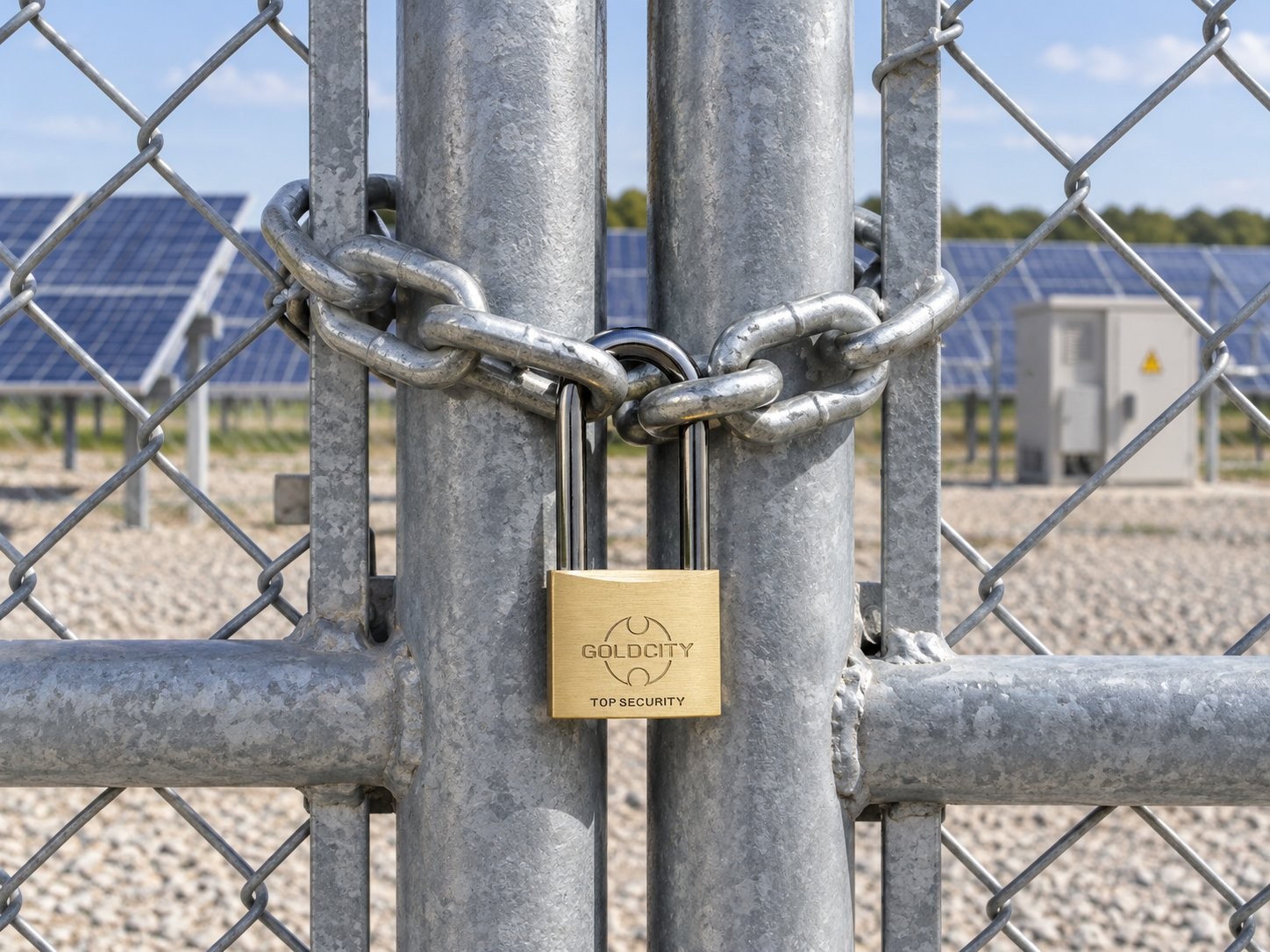
More reach is useful only when the application needs it. If a shorter shackle closes freely, adding unnecessary exposed length does not improve the installation.
Site condition | Padlock configuration to evaluate | Main procurement check |
Standard gate hasp | Standard-shackle industrial padlock | Hole size and body clearance |
Thick chain or offset eye | Long shackle padlock | Required reach and exposed clearance |
Restricted installation space | Compact body geometry | Body movement and key access |
Multiple controlled gates | Keyed-alike or master-key system | Access hierarchy and records |
Exposed outdoor site | Construction suited to site conditions | Moisture, dust and maintenance |
Product construction and project security requirements should remain separate fields in the specification.
Features such as a hardened shackle, double-locking mechanism or protected body geometry can help buyers compare designs, but a construction feature is not the same thing as a named security certification. When an insurer, consultant or project specification calls for a particular standard or attack test, request evidence for the exact model being reviewed.
That approach also makes quotations easier to compare. Suppliers are responding to the same requirement instead of interpreting terms such as “high security” or “heavy duty” differently.
Solar farms operate outdoors, but there is no single “outdoor environment.” An inland array, a humid agricultural site and a coastal project expose hardware to different conditions. Key management can vary just as much. One installation may have a small permanent maintenance team, while another uses contractors, regional supervisors and several controlled compounds.
Rain, persistent humidity, dust, airborne salt and maintenance frequency belong in the sourcing brief. A coastal or highly exposed site may need different material choices from a dry inland project.
Avoid turning “weatherproof” into a generic purchasing requirement unless the requested performance can be defined and verified. A better RFQ describes where the padlock will operate and asks the supplier to confirm a suitable candidate and any supporting test information required by the project.
For buyers, this is more useful than choosing a material name first and trying to make every site fit the same product.
With several access points, key management can quickly become an operational issue.
Keyed-alike groups can reduce the number of keys carried by one authorized team. A master-key structure can provide wider access for supervisors while maintaining separate groups below it. GOLD CITY's Steel Ball Locking Brass Padlock with Master Key, NO.6001-6020, is one product family that can be evaluated where this type of mechanical access hierarchy matches the project. The current range includes multiple body sizes and packing configurations.
The keying plan should be agreed before production. Record who controls spare keys, which groups can be opened by the master key and what reference will be used when additional locks are ordered later.
With geometry, environment and keying defined, buyers can shortlist products on a much stronger basis than body size or unit price alone.
GOLD CITY has manufactured padlocks since 1975 and supplies international B2B markets from its factory in Haining, Zhejiang. Its published company information lists more than 200 employees, annual padlock production above 10 million pieces and ISO 9001:2015 management accreditation. For a solar project, those manufacturing capabilities matter most when they are paired with a clear application specification and sample approval process.
A conventional heavy-duty brass padlock can suit compatible gate hardware where the required body and shackle geometry match. Larger industrial fittings may call for a different format. GOLD CITY's Hardened Steel Padlock range, for example, includes 66 mm, 75 mm and 84 mm models that give project buyers another geometry to compare for larger locking points.
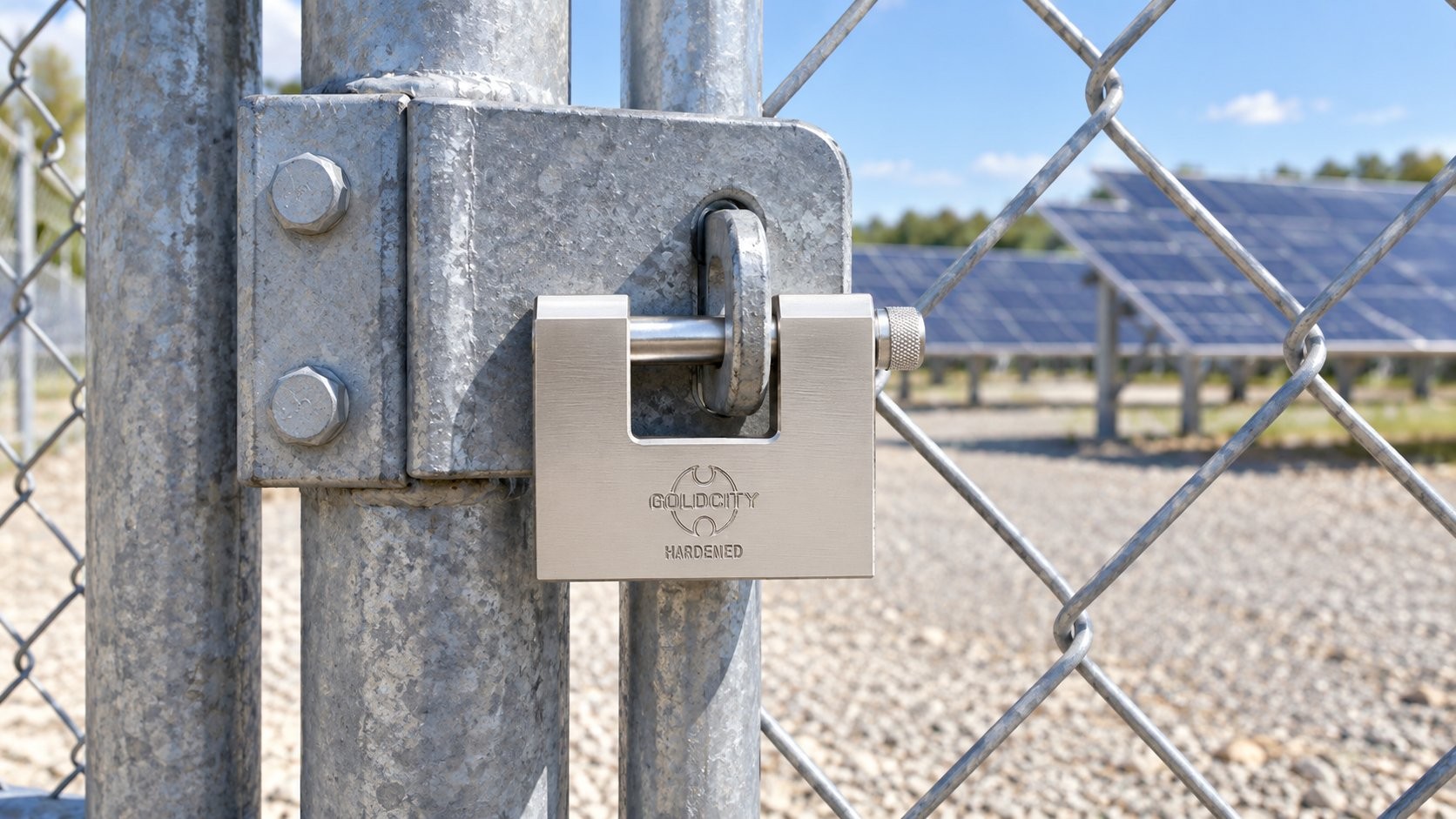
The important step is comparison against the actual installation. A larger lock should not be selected simply because a gate is part of a critical-infrastructure site.
A workable solar farm padlock RFQ should cover:
· Gate, chain or hasp photographs and critical dimensions
· Quantity by site or locking-point group
· Required shackle geometry
· Operating environment
· Keyed-different, keyed-alike or master-key arrangement
· Required project tests or documentation
· Packing, destination market and sample quantity
Test the candidate sample on the actual gate or a dimensionally representative fixture. Check insertion, locking, unlocking, body clearance and key access. Keep the approved model, drawing or measurements, keying reference and packing requirement together for repeat orders.
Six months later, that record is much more useful than an old email saying “same lock as last time.”
Solar farm security planning in 2026 increasingly treats physical access as part of a wider risk-based security strategy. At the gate, a good specification starts with the locking point and moves through shackle geometry, environmental exposure, key control, required evidence and sample approval.
For projects that need mechanical gate-locking solutions, GOLD CITY can review application details and suitable padlock formats for bulk supply. Buyers can contact GOLD CITY with gate photos, dimensions, quantity, keying requirements, destination market and sample needs.
A: Start with the gate or chain rather than a product label. Check the receiving-hole size, required shackle opening, body clearance, outdoor exposure, keying arrangement and any project-specific security requirements before selecting a model.
A: Measure the actual receiving point first. Body width alone does not confirm fit; shackle diameter, usable height and width, and available space around the lock body also matter.
A: A long shackle padlock is useful when a thick chain, offset eye or awkward hasp needs additional reach. Where a standard shackle fits correctly, extra length is usually unnecessary.
A: Yes. Keyed-alike groups can simplify access for designated teams, while a master-key arrangement can provide broader access for supervisors. The hierarchy should be specified before production.
A: Include site photos, locking-point dimensions, quantity, shackle requirement, environment, keying plan, required documentation, packing, destination market and sample requirements.
TEL: +86-573-87471884 / 87471697
FAX: +86-573-87471537
Address: No. 205 Xinjiang Road Changan Haining, Zhejiang, China
E-mail: howardshen@263.net, goldcitylock@hotmail.com
 浙公网安备33048102250808号